
Introduction: Why GPT-6.1 Terra Matters
Artificial intelligence is becoming more powerful, but there is one challenge that developers and businesses continue to face: balancing performance with cost.
On October 26, 2026, OpenAI introduced GPT-6.1 Terra, a model designed to handle practical AI tasks more efficiently while reducing the cost of using AI at scale.
Unlike AI announcements that focus mainly on making models bigger or more intelligent, GPT-6.1 Terra places particular emphasis on getting useful work done. This includes understanding images, interacting with software, writing natural text, and completing tasks across digital tools.
One of the biggest highlights is its lower API pricing. OpenAI says GPT-6.1 Terra offers a significant improvement over its predecessor, GPT-5.6 Terra, with standard API prices reduced by approximately 50% or more, depending on token type.OpenAI, OpenAI API, OpenAI Developer Community
But does lower pricing make it the right choice for everyone?
In this article, we’ll explore GPT-6.1 Terra features, pricing, performance, real-world applications, and limitations to understand where it fits into today’s AI landscape.
I really got amazed when I saw this update and I wonder how the OpenAI is getting advanced day by day.
Every update is getting exceptional one after one. Every AI tool is surely beneficial for every individual who is working or linked with AI.
I am really excited to share the update with all audiences and make the article more informational and beneficial for you guys.
What Is GPT-6.1 Terra?
GPT-6.1 Terra is an AI model developed by OpenAI to perform everyday digital tasks involving language, images, reasoning, and software interaction.
In simple terms, imagine having an AI assistant that can understand a screenshot, explain a technical document, help draft an email, or assist with tasks inside an application.
Instead of focusing exclusively on answering questions, GPT-6.1 Terra is designed to support actions and workflows.
For example, a business might use it to examine product photographs and match them with catalog entries. A developer could use it to help interpret an application screen or generate structured information from documents.
The model supports a context window of 1,050,000 tokens and a maximum output of 128,000 tokens through the API. These limits allow it to process substantial amounts of information, although practical performance and costs still depend on the workload.GPT-6.1, MODELS OpenAI API
The main idea: GPT-6.1 Terra is intended to offer capable AI assistance without requiring businesses to use a more expensive flagship model for every task.
GPT-6.1 Terra Features: What’s New?

The most interesting GPT-6.1 Terra features focus on practical tasks rather than simply generating longer answers.
Improved visual understanding
GPT-6.1 Terra can interpret images and visual information, making it useful for tasks that involve product photography, technical diagrams, and application screenshots.
For example, an online retailer could use the model to compare product images with inventory records. This could reduce some of the manual work involved in organizing large catalogs.
However, AI-generated matches should still be checked when accuracy is important.
More precise computer use
Another important capability is computer interaction.
GPT-6.1 Terra can work with supported tools to understand application screens and carry out digital workflows. This could help with repetitive administrative tasks, navigating software, and handling information across applications.
It is important to distinguish model capability from unrestricted access: actual actions depend on the tools, permissions, and environment provided.
Clearer and more natural writing
Writing is another area of focus.
Businesses can use GPT-6.1 Terra to draft professional emails, summarize documents, prepare reports, or rewrite complicated information in simpler language.
That doesn’t mean everything it produces is automatically ready for publication. Human editing is still essential for factual accuracy, tone, and originality.
Adjustable reasoning effort
Developers can choose different reasoning-effort settings, including none, low, medium, high, xhigh, and max.
This flexibility lets them experiment with the trade-off between response quality, processing time, and token usage. OpenAI recommends starting at medium effort and testing higher settings when necessary.GPT-6.1 Terra MODEL , Using GPT-6.1
GPT-6.1 Terra Pricing: How Much Does It Cost?
Pricing is one of the biggest reasons developers may consider switching to GPT-6.1 Terra.
OpenAI’s standard API pricing is based primarily on tokens. A token is a small unit of text processed or generated by the model.
GPT-6.1 TERRA — STANDARD API PRICING
$1.00 $0.05 $5.00
Input Cached input Output
USD per 1 million tokens. Standard rates; additional charges may apply for tools, processing modes, or long-context requests.
For comparison, GPT-5.6 Terra’s currently listed standard rates are $2 per million input tokens, $0.20 for cached input, and $12 for output.GPT-5.6 Terra , GPT-6.1 Terra
| Token type | GPT-5.6 Terra | GPT-6.1 Terra |
|---|---|---|
| Input | $2.00 | $1.00 |
| Cached input | $0.20 | $0.05 |
| Output | $12.00 | $5.00 |
This represents a 50% reduction in input costs, a 75% reduction in cached-input costs, and approximately a 58% reduction in output costs.
To make this easier to understand, imagine a business processing one million input tokens and generating 200,000 output tokens, without caching or additional tool charges.
GPT-5.6 Terra would cost approximately $4.40, while GPT-6.1 Terra would cost $2.00 for the same token quantities.
The difference becomes more meaningful as usage increases.
Batch and Flex processing can offer further discounts, although these options have different processing characteristics.Pricing
GPT-6.1 Terra vs GPT-5.6 Terra: Performance Comparison
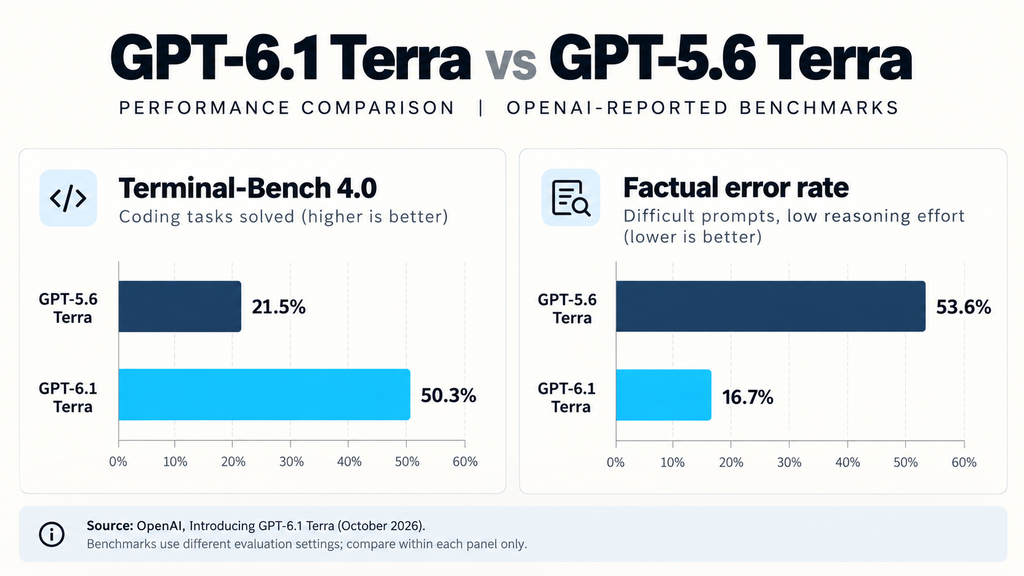
Coding benchmark: Terminal-Bench 4.0
Task success rate at maximum reasoning effort. Source: OpenAI official launch announcement.
| Benchmark | Official reported result |
|---|---|
| Terminal-Bench 4.0 | 50.3% of tasks solved vs 21.5% |
| Factual-error evaluation | Error rate fell from 53.6% to 16.7% at low reasoning effort |
| Agents’ Last Exam | 15 percentage-point improvement at medium effort |
| Task completion speed | Over 3× faster than GPT-6 Astra and GPT-6.1 Sol in OpenAI’s reported evaluation |
Performance is not only about how quickly an AI responds. It also matters whether the model completes tasks correctly, follows instructions, and produces reliable information.
OpenAI’s official benchmark results show several improvements over GPT-5.6 Terra.
These results suggest that GPT-6.1 Terra is becoming more capable at coding, computer use, and factual reasoning.
For example, its improved performance on Terminal-Bench indicates that it can solve a larger proportion of tested command-line software engineering problems.
The reduction in factual errors is also encouraging, particularly for businesses using AI to process information.
However, these figures come from OpenAI’s evaluations. They should not be interpreted as a guarantee of identical improvements in every real-world application.
A business considering migration should test both models using its own documents, tasks, and accuracy requirements.
Performance analysis
I think the most interesting thing about this update is now Terra is getting more efficient with the answers and to give more relatable suggestions rather than the previous one.
For the businesses, it doesn’t matter the small or the big industries this update gives an incredible experience to work with.
However, I worked on it by myself and had an amazing experience with it. I am pretty sure the details and the update I will share with all of you definitely it’s going to be worth it.
Practical Uses: How Businesses and Developers Can Benefit

Image placement: AI-assisted business workflow. Choose a commercially licensed photo before publishing.
The real value of GPT-6.1 Terra may become clearer when we look at how it could help businesses solve everyday problems.
Business administration and accounting
Consider a company that receives dozens of invoices every day.
Instead of manually copying every invoice number, date, and amount into accounting software, an AI-powered workflow could extract relevant information and prepare it for entry.
GPT-6.1 Terra’s visual understanding and computer-use capabilities make it a potential component of this type of system.
Human approval would remain important for financial records and payments.
E-commerce and product management
Online stores often handle hundreds or thousands of product images.
Developers could use GPT-6.1 Terra to build systems that compare photographs with product catalogs, identify possible mismatches, or help organize inventory information.
Content creation and marketing
Digital marketing teams could use the model to draft emails, create content outlines, rewrite product descriptions, and summarize campaign information.
Its natural writing capabilities may reduce editing time, but marketers should still contribute original insights and verify claims.
Software development
Developers could use GPT-6.1 Terra to assist with debugging, interpreting screenshots, generating code, or working through supported development tools.
For repetitive and moderately complex tasks, the lower API pricing could make experimentation more affordable.
These examples are potential applications, not independently verified customer success stories. The actual benefits depend on implementation quality and testing.
GPT-6.1 Terra Limitations: Is It Always the Best Choice?
Despite its improvements, GPT-6.1 Terra is not designed to replace every other AI model.
For demanding research, complicated software engineering, or tasks requiring the strongest available reasoning, OpenAI recommends more capable models such as GPT-6.1 Sol and GPT-6 Astra.Using GPT-6
There are also practical limitations to consider.
AI-generated information can still contain mistakes, particularly when tasks involve ambiguous instructions or incomplete source material.
Computer automation introduces additional concerns because an incorrect action could affect business records, application settings, or customer information.
Developers should therefore use appropriate permissions, validation steps, and human approval for sensitive actions.
Another limitation is cost predictability. Although GPT-6.1 Terra has lower standard token prices, extensive tool usage, longer contexts, and additional processing can increase total expenses.
The most effective approach is to select a model according to the difficulty and risk of the task rather than assuming the newest option is always the best.
How to Access GPT-6.1 Terra
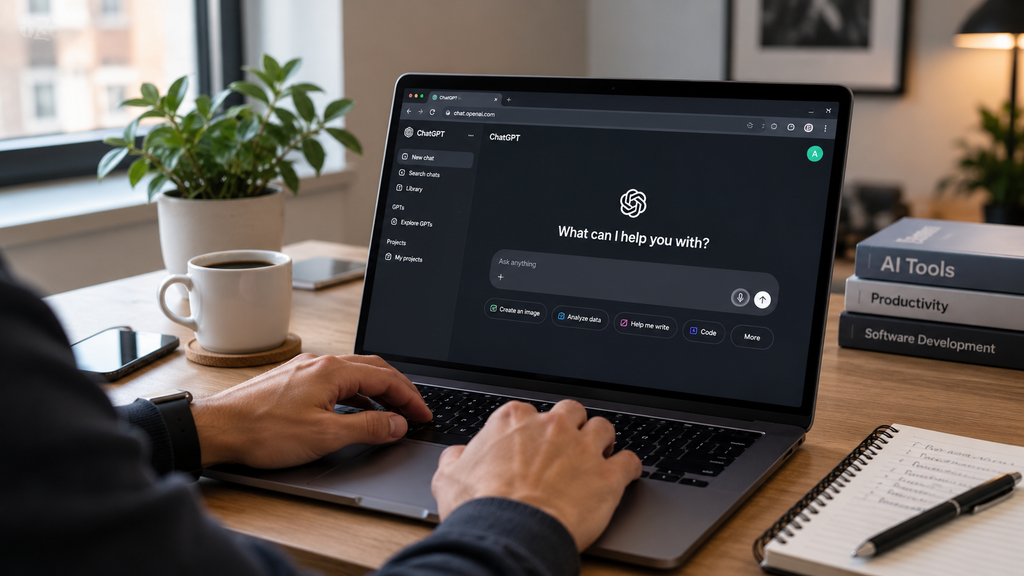
OpenAI has made GPT-6.1 Terra available through several products.
ChatGPT Work: According to OpenAI’s launch announcement, GPT-6.1 Terra is available to Plus, Pro, Enterprise, and Edu users in ChatGPT Work. Work is intended for completing more substantial tasks involving files, tools, and applications.
Codex: Developers can use GPT-6.1 Terra in Codex for supported software development workflows.
OpenAI API: Developers can integrate the model into their own applications using the model identifier gpt-6.1-terra.
OpenAI’s documentation also explains that the tool calling for GPT-6.1 Terra requires the Responses API.Introducing GPT-6.1 Terra
For developers getting started, the official documentation provides model specifications, pricing information, and implementation guidance.
Official GPT-6.1 Terra API documentation
Conclusion
GPT-6.1 Terra represents an important development in making capable AI more affordable for practical work.
Its improved visual understanding, computer-use performance, natural writing, and lower API pricing make it worth considering for businesses and developers building AI-assisted workflows.
Compared with GPT-5.6 Terra, the new model offers measurable improvements across several official benchmarks while reducing token costs.
However, businesses should evaluate those advantages against their own needs. For highly complex tasks, GPT-6.1 Sol or GPT-6 Astra may remain more appropriate.
Ultimately, the most interesting aspect of GPT-6.1 Terra isn’t simply that it is cheaper or faster. It is the possibility of making useful AI automation more accessible to teams that previously found it too expensive or difficult to implement.
As AI continues to evolve, the models that deliver dependable results at sustainable costs may prove just as valuable as those that achieve the highest benchmark scores.
I think the lower cost could be more beneficial for the small businesses because they can evaluate with the trend and get more advanced without taking the headache of paying higher cost to the tools.
In this way, they can compete with the market and get more benefit from it in terms of solving daily tasks that consume more of their time.
Discover smarter ways to work with the latest AI tools, reviews, and recommendations at TechsNeurons.