
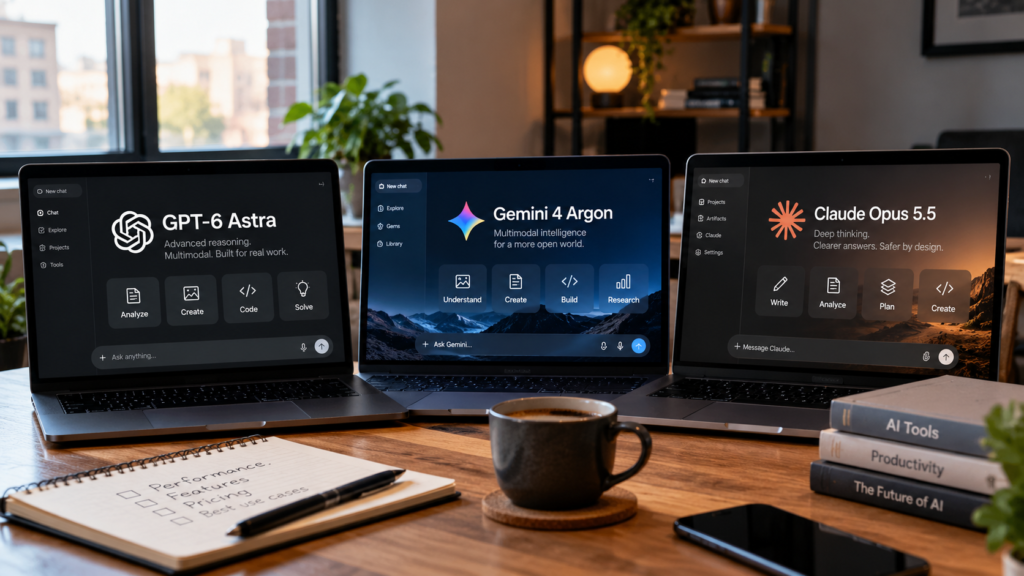
Introduction: Three Powerful AI Models, but Which One Deserves Your Money?
A few years ago, choosing an AI assistant was relatively simple. Today, it’s a different story.
OpenAI, Google, and Anthropic are competing to build models that can write code, solve difficult problems, analyze documents, and handle increasingly complicated work. Their latest contenders—GPT-6 Astra, Gemini 4 Argon, and Claude Opus 5.5—bring impressive capabilities to the table.
But there’s a question that matters more than the announcements: Are you actually getting enough value to justify paying for one?
A model might perform exceptionally well on a benchmark and still be unnecessary for someone who only needs help writing emails or researching everyday topics.
In this comparison, we’ll look beyond the promotional claims. We’ll examine published benchmark results, API costs, practical strengths, and limitations to understand which model makes sense for different users.
When I saw the recent updates across all Ai platforms, I decided to compare some trending ones so I can get a more clear and authentic idea of which tool is giving the best of it to solving tasks from daily bases to most advanced ones.
I am super excited while writing this article to show you guys how a better toll could be more beneficial for you in every aspect of your life.
When I did research on it and did an experiment across all tools I found some interesting and eye-catching results to show you guys.
Let’s discuss that!
Meet the Contenders: What Makes Each AI Different?
GPT-6 Astra — OpenAI’s premium model
GPT-6 Astra is OpenAI’s flagship model, developed for advanced reasoning, professional tasks, software engineering, and computer use.
OpenAI reports substantial improvements in mathematics, complex workflows, and coding. Astra is available through eligible ChatGPT plans and the API.GPT-6 ASTRA
Its appeal is strongest when difficult tasks justify the additional cost.
Gemini 4 Argon — Google’s frontier competitor
Gemini 4 Argon focuses on advanced reasoning, visual understanding, engineering, and professional knowledge work.
Google’s model card highlights applications in finance, science, legal analysis, and multimodal document processing.Gemini 4 Argon
It is especially interesting for users who work with large amounts of information or already rely on Google’s tools.
Claude Opus 5.5 — Anthropic’s coding-focused contender
Claude Opus 5.5 is designed for demanding software development and knowledge-work tasks.
Anthropic positions it as a capable option for complex coding workflows, particularly when developers need to work through problems involving multiple steps.Opus 5.5, Anthropic releases
Its value depends on how well it handles your actual projects rather than benchmark scores alone.
Features Comparison: What Can These Models Actually Do?
All three models support advanced reasoning and software development, but their strengths aren’t identical.
GPT-6 Astra places considerable emphasis on computer use and complex professional workflows. Gemini 4 Argon combines reasoning with visual understanding and broad knowledge-work applications. Claude Opus 5.5 has attracted attention for its coding performance and developer workflows.
| Feature | GPT-6 Astra | Gemini 4 Argon | Claude Opus 5.5 |
|---|---|---|---|
| Advanced reasoning | Yes | Yes | Yes |
| Coding and debugging | Yes | Yes | Yes |
| Writing and research | Yes | Yes | Yes |
| Multimodal understanding | Yes | Yes | Yes |
| Professional workflows | Yes | Yes | Yes |
| Developer API | Yes | Yes | Yes |
This table tells us what the models can do, but not how well they do it.
For example, two models may both generate working code, yet one might require fewer corrections. Similarly, one may produce more natural writing while another follows detailed formatting instructions more consistently.
Those differences are difficult to capture in a simple feature checklist.
The better question is whether a model performs your particular task accurately, consistently, and at a reasonable cost.
Performance Comparison: What Do the Actual Benchmarks Show?
This is where the comparison becomes more interesting.
Google DeepMind’s official Gemini 4 Argon model card includes results for all three models on several shared evaluations. That gives us a useful starting point, although the numbers remain provider-published results and should be interpreted alongside their methodology.Gemini 4 Argon
Coding performance: Claude takes the lead on Terminal-Bench
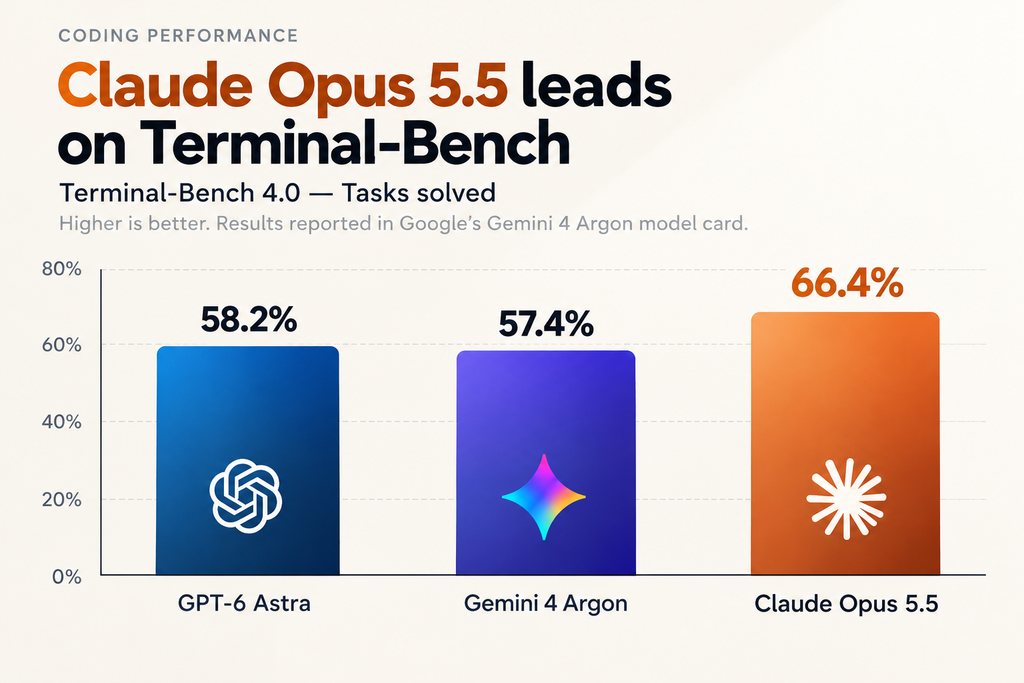
Source: Google DeepMind’s published evaluation table, October 2026. .Gemini 4 Argon
Claude Opus 5.5 leads this particular coding benchmark with 66.4%, compared with 58.2% for GPT-6 Astra and 57.4% for Gemini 4 Argon.
That is a meaningful difference, but it doesn’t settle the entire coding debate.
On DeepSWE v1.1, Gemini 4 Argon scores 77.9%, ahead of Claude Opus 5.5 at 74.2% and GPT-6 Astra at 74.1%.
On FrontierSWE v2, the order changes again: GPT-6 Astra leads with 65.5%, followed by Claude at 62.3% and Gemini at 55.0%.Gemini 4 Argon
What does this mean? Different coding benchmarks test different abilities. A model that performs best on command-line tasks might not be the strongest choice for every software engineering project.
Professional work: Gemini shows an advantage
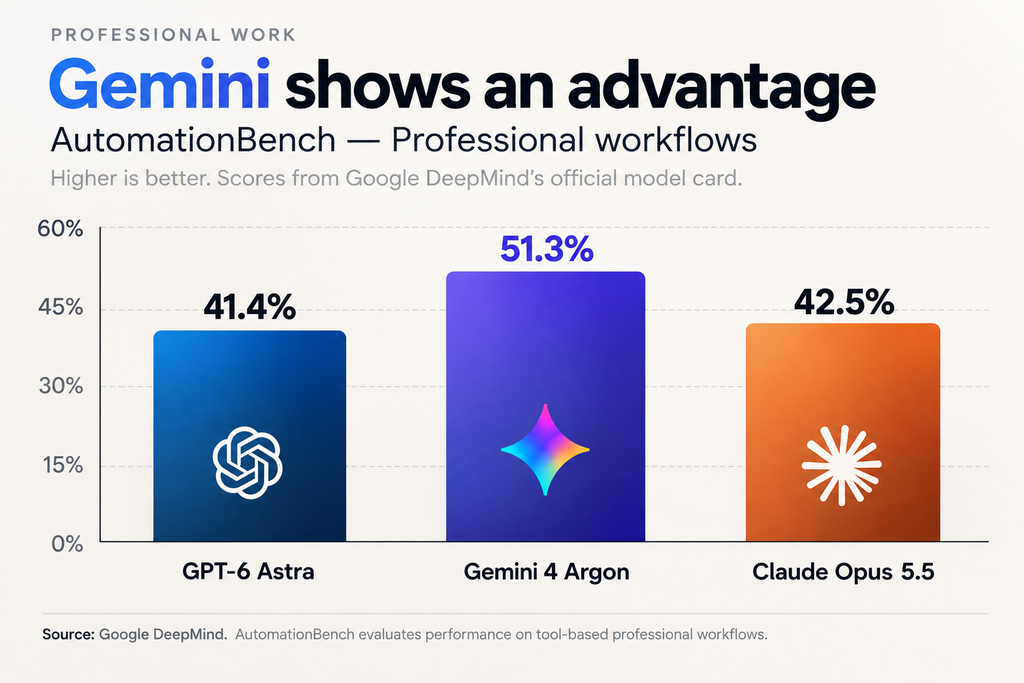
Source: Google DeepMind. AutomationBench evaluates performance on tool-based professional workflows.
Gemini 4 Argon leads this evaluation with 51.3%.
For businesses, this is worth paying attention to. Professional workflows often involve multiple steps, such as gathering information, updating records, and preparing reports.
However, a benchmark score is not the same as a guarantee that an AI system can reliably run a business without supervision.
Reasoning and research: No universal winner
On Google’s reported LABBench 2 science evaluation, Gemini 4 Argon scores 88.8%, GPT-6 Astra scores 85.4%, and Claude Opus 5.5 scores 73.1%.
Yet GPT-6 Astra leads the same model-card comparison on Terminal-Bench Science 0.1 with 68.1%, ahead of Claude at 63.3% and Gemini at 57.6%.Gemini 4 Argon
These results reinforce an important point: the winner depends on the type of problem being tested.
For writing quality, there is no equally straightforward universal score. A more useful approach is to compare the models using the same writing brief and judge clarity, factual accuracy, tone, and editing effort.
Analyze the results
I am in shock after seeing these results and analysis, as we discussed in our previous article in which we disclose the features of GPT-6.1.
I wonder how Gemini is having a lead across every aspect of the experiment.
Not looking down to other tools but still there is a clear difference of margin, surely the other tools have some specific functions to do that the other can’t do.
So let’s move ahead with some more convincing ideas and experiments to get a better view.
Pricing Comparison: Is Paying More Really Worth It?
Performance matters, but pricing can change the entire decision.
A model that delivers slightly better results at several times the cost may not be the most practical choice for everyday work.
For developers, API pricing offers a useful comparison because it shows how much each provider charges to process and generate text.
Official API pricing
USD per 1 million tokens, standard rates as of October 27, 2026
| Model | Input | Output |
| GPT-6 Astra | $10 | $50 |
| Gemini 4 Argon | $2 | $10 |
| Claude Opus 5.5 | $4 | $20 |
difference, consider an application processing one million input tokens and producing 200,000 output tokens.
Try the API cost comparison:
Input tokens = 100000
Output tokens = 200000
GPT-6 Astra Gemini 4 Argon Claude Opus 5.5
$11.00 $2.20 $4.40
Illustrative standard API costs only. Excludes caching, tools, taxes, and other charges. Gemini uses its October introductory rates.
Gemini is currently the least expensive of these three models on standard API token rates.
But don’t confuse API pricing with monthly ChatGPT, Gemini, or Claude subscriptions. Consumer plans have their own fees, features, and usage limits, and access to a specific model may vary.
For someone who mainly writes emails, researches topics, or summarizes documents, a lower-priced subscription—or even a free plan—may be sufficient.
Real-World Use Cases: Which AI Makes Sense for Your Work?

Benchmarks are useful, but most people aren’t paying for AI to win benchmark competitions. They’re paying to get work done.
For developers
Claude Opus 5.5’s Terminal-Bench performance makes it an interesting option for command-line coding workflows. GPT-6 Astra and Gemini 4 Argon also perform competitively across other engineering evaluations.
Developers should test all three on their own codebases before deciding.
For content creators
Writing a blog involves more than generating paragraphs. You need research, organization, factual accuracy, editing, and a natural voice.
All three models can help with these tasks, but there is insufficient comparable evidence here to declare one the best writer.
A practical test would be to give each model the same article brief and compare how much editing its output requires.
For businesses
Gemini 4 Argon’s reported AutomationBench advantage makes it worth evaluating for professional workflows.
However, the right model also depends on existing software integrations, data-handling requirements, and reliability.
For students and researchers
GPT-6 Astra and Gemini 4 Argon have strong published results on different science evaluations.
Neither should be treated as an unquestionable source of facts. Students and researchers should verify important claims using primary references.
My Experiment Results: ChatGPT vs Claude vs Gemini
I gave all three AI tools the same business problem to see how well they could identify operational issues and suggest practical solutions.
ChatGPT: I found ChatGPT’s response more structured and easier to follow. It provided a clear 30-day improvement plan with weekly priorities, estimated working hours, and measurable goals. However, it focused more on internal management and didn’t explore client-related problems in much detail.
Claude: Claude took a slightly different approach. Instead of just focusing on task management, it highlighted workload capacity, client approval delays, and scope creep. I found its suggestions more realistic from a business perspective, although some recommendations, like limiting revisions and setting fixed approval times, would need adjustments depending on the agency.
Gemini: Interestingly, the Gemini response I collected was identical to Claude’s. I couldn’t identify any meaningful differences between them, so I would need to verify the original response before making a fair comparison.
What I Learned
ChatGPT was better at organizing a clear action plan, while Claude was stronger at identifying possible underlying business problems.
One thing I noticed was that the responses suggested performance targets without knowing the agency’s actual workload or past results.
My verdict: For this experiment, I preferred Claude’s problem analysis and ChatGPT’s structured planning. Combining both approaches would probably produce a more useful solution. I couldn’t fairly rank Gemini because of the duplicate response issue.
Limitations: What the Benchmarks Don’t Tell You
Even the most advanced AI models can make mistakes.
They may generate incorrect facts, misunderstand instructions, or provide confident answers without sufficient evidence. Google explicitly identifies hallucinations and occasional slowness or timeouts among Gemini 4 Argon’s known limitations.Gemini 4 Argon
There are also practical concerns that benchmarks rarely capture.
A model might be excellent at solving a difficult coding challenge but produce an unnecessarily complicated answer to a simple question. Another might generate polished writing that still requires substantial fact-checking.
Subscription limits matter too. Paying for an AI plan doesn’t necessarily provide unlimited access to its most advanced model.
Finally, many published evaluations come from the companies developing the models. Their findings are useful, but independent testing is important when making strong claims about superiority.
For everyday users, consistency, ease of use, and affordability may matter more than a small difference in benchmark scores.
Final Verdict: Which AI Should You Actually Choose?
There isn’t one model that wins every category.
For demanding coding workflows: Claude Opus 5.5 deserves consideration.\
It leads the published Terminal-Bench 4.0 comparison, although other coding evaluations favor GPT-6 Astra or Gemini 4 Argon.
For professional workflow automation: Evaluate Gemini 4 Argon.
Its AutomationBench results are promising, but actual reliability must be tested within your business processes.
For difficult reasoning and specialized work: Consider GPT-6 Astra.
It performs strongly across several advanced evaluations, although its premium API pricing may be unnecessary for simpler tasks.
For lower API costs: Gemini 4 Argon currently has the advantage.
Its introductory standard token prices are the lowest of the three, but the scheduled price increase matters for longer-term planning.
For writing and research, I would avoid naming a universal winner without comparable hands-on tests.
The best purchase is the model that completes your actual work accurately, with the least effort and at a price you can justify.
Frequently Asked Questions
Which AI model is best in 2026?
There is no universal winner. GPT-6 Astra, Gemini 4 Argon, and Claude Opus 5.5 perform differently depending on the task, benchmark, and evaluation conditions.
Is GPT-6 Astra better than Claude Opus 5.5?
Not in every category. Claude leads the published Terminal-Bench 4.0 comparison, while GPT-6 Astra leads certain other engineering evaluations.
Which AI is best for coding?
Claude Opus 5.5 is a strong candidate for terminal-based coding tasks, but GPT-6 Astra and Gemini 4 Argon also lead on different software engineering benchmarks.
Which AI offers the best value for money?
For standard API token pricing in October 2026, Gemini 4 Argon is the cheapest of the three. For subscriptions, value depends on plan access, usage limits, and the work you perform.
Conclusion
The competition between GPT-6 Astra, Gemini 4 Argon, and Claude Opus 5.5 shows how difficult it has become to choose a single AI assistant.
Each model has strengths, but none dominates every published evaluation.
For developers, benchmark performance and reliability may justify a premium price. For businesses, workflow integration could matter more. And for everyday users, the most affordable model that consistently completes the job may be the smartest choice.
Before subscribing, test the models against your own tasks. The results might surprise you.
Make smarter decisions with honest reviews, expert insights, and technology comparisons from TechsNeurons.